Oh, gross anatomy. Some people love it, some people hate it, and some people (like myself) are somewhere in between. Gross anatomy is an invaluable learning experience, and I am so thankful to have had the opportunity to be in the lab. You will have a new appreciation for how truly amazing the human body is after this class. However, I’m not going to lie, it can also be pretty overwhelming at times. My program includes gross anatomy during the first semester of PT school, which, for us, is an 11-week summer session. As you can imagine, the human body is complicated, and there is so much to learn in such a short amount of time!
What is the schedule like and what do you cover?
We had gross anatomy Monday-Friday from 9-12. We had some class lectures, but the majority of that time was spent in the lab completing dissections. I was very hesitant and uneasy about completing dissections at first, and honestly, that feeling never completely went away. Some dissections got to me more than others, but it does get easier! I was lucky to have an amazing dissection group who helped get me through it when I was having a rough day. We covered the entire human body: upper and lower extremity, trunk, head, and neck. My favorites were upper/lower extremity and the brain. Seeing and touching the muscles and structures in lab is SO helpful as you continue through PT school. The hardest part was most definitely head and neck…there are so many nerves!
What do you wear and bring to lab?
My personal rule of thumb was whatever went into the lab stayed in the lab. My school provided us with hooks at our table, so I kept an old pair of yoga pants and a t-shirt in there and would change each day when I arrived. Many of my classmates kept a cheap pair of scrubs on their hooks and slipped them on over their clothes at the beginning of class. I forgot to bring an old pair of shoes from home, so I went to Wal-Mart and bought a $10 pair of tennis shoes that I kept in the lab with my clothes. Yes, my feet definitely hurt, but whatever shoes you choose to wear will likely be ruined, so keep that in mind. We also wore lab coats, masks, gloves, and face shields (it was quite the outfit). I believe the face shields were a new addition due to COVID, however, after seeing how many times I had to clean it I was happy to wear one. I, along with many of my classmates, just tossed everything straight into the trashcan at the end of the semester. A few people were able to get the smell out of their scrubs, but it is very difficult.
As far as what to bring to lab, my program had an anatomy atlas at each table for us to use. I don’t recommend bringing books/notes into the lab because they will likely get ruined. Classmates that used scrubs over their clothes usually just brought their keys and phone. I brought either my bookbag or a small tote bag to hold my change of clothes and shoes. There was a corner of the lab far away from the cadaver tables where we placed all of our belongings. My program also provides us with lockers, so I would drop my lunch, water bottle, jacket, etc. in there before heading to lab each day. I highly recommend getting a locker if you have the opportunity for this reason!
How were lab practicals set up?
For practical exams, the tables were all lined up in the center of the room, and we would rotate to each cadaver/station, marking answers on a scantron. Each station had two multiple choice questions. Some questions asked you to identify the pinned muscle, nerve, or blood vessel, whereas others asked “what innervates the pinned structure” or “what is this muscle’s origin?” The majority of our questions were on cadavers, but we also had a handful of questions each exam on bones, models, and radiographs. We received 1-2 minutes per station (I can’t remember the exact time). At first, I was worried about the time limit, but I rarely ran out of time. My program also did a practice practical before the first one, which helped to relieve some anxiety about how the process worked.
How do you study?
I wish there was one answer to this question to make it easier for everyone, but it truly varies from person to person, and it may take you a while to figure out what works best for you. After the first exam, you will have a better idea of how to succeed, so don’t get discouraged if you don’t do as well as you want! Here are some things that worked for me:
Do not only study your cadaver! – I cannot stress this enough! The three hours of lab each day were usually almost entirely spent doing the dissection. This means during that time, my group and I only saw the structures on our cadaver. However, one thing you will learn in gross anatomy is how much variation there is from person to person. Fortunately, we were able to go into the lab anytime. As much as I did not want to go back after a long day of class, it was so important for my success because on the practical they use all of the cadavers and each one looks so different. On the weekend before each practical, my lab group and I would go to the lab and study every cadaver making sure we could pick out the structures on each one.
Utilize tutoring hours – We had four teaching assistants from the medical school who offered tutoring in the lab each week, and I always took advantage of it. They not only answered questions, but they would quiz us to help prepare us for the exam.
Anki – I utilized several online resources which I will provide links to below, but what I used the most was probably Anki. Each unit had a written exam in addition to the practical, and Anki worked particularly well for the written portion. If you are not familiar with Anki, it is a flashcard program that utilizes spaced repetition to help you learn. Many medical students use it, and the medical students at my school graciously shared their Anki decks with us. I am usually a Quizlet fan, however, for gross anatomy I actually preferred Anki. It is easy to use and it’s free!
Draw things out! – I have stacks and stacks of papers with drawings of blood vessels and nerves from gross anatomy. Learning all of the pathways was one of the hardest parts for me, and drawing them out is what helped me the most. During our head and neck unit, I remember getting up every morning and drawing out each of the cranial nerves on my whiteboard. I also came up with countless mnemonics that I would write out over and over. It may seem silly at the time, but if it helps you learn, then so be it!
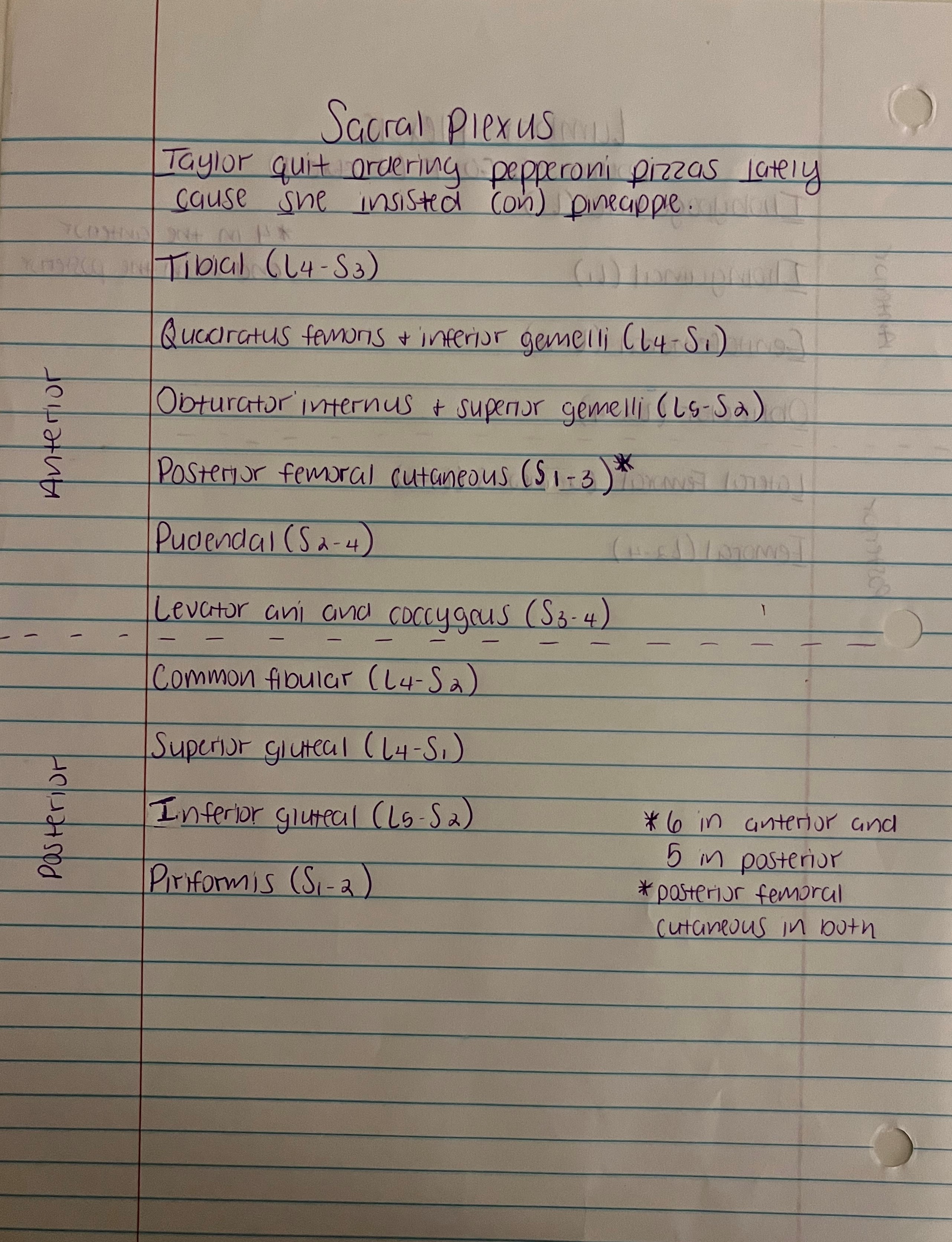


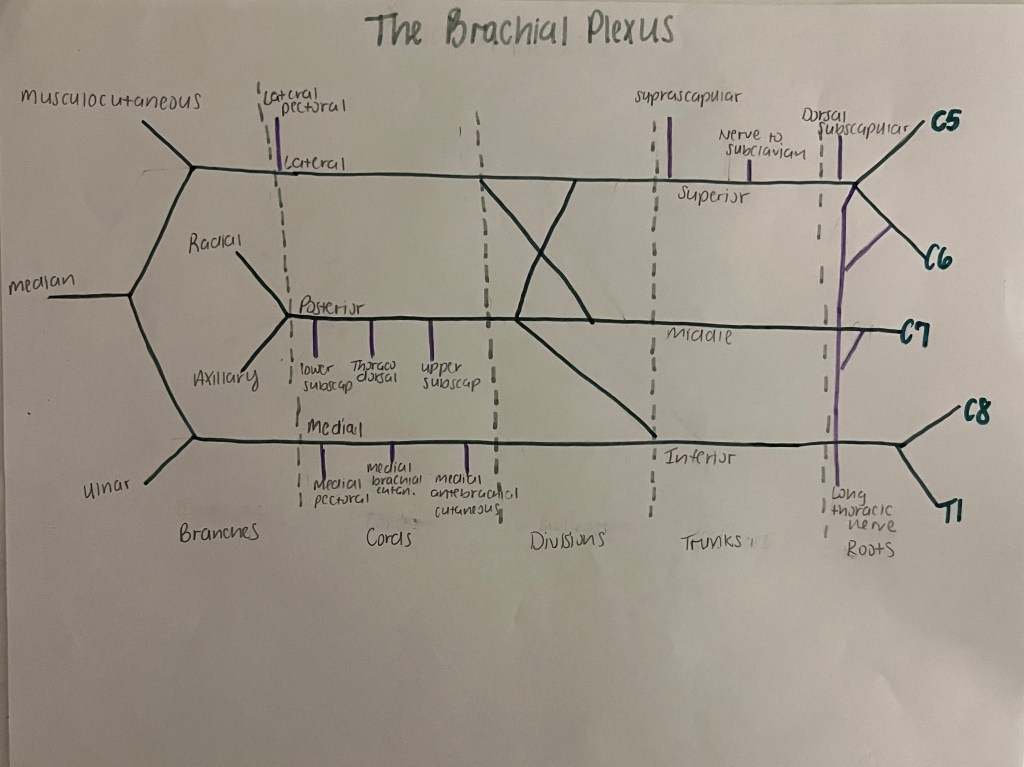
Take part in both individual and group studying – I think this applies to almost any class in PT school. I’ll start by studying a topic myself, and once I start to grasp it I will talk through it with classmates. This allows us to teach one another, come up with ways to remember information, and answer each others’ questions. My roommate and I spent many, many days at the pool last summer with our muscle charts or gross anatomy textbooks quizzing one another. Call me crazy, but everything is better when you’re at the pool, right?

Here are links to some resources I found to be helpful!
- Sam Webster on YouTube – I didn’t discover this channel until later on in gross anatomy, and I wish I would have found it earlier. His videos are longer, but they are so helpful! He also used the same models that we had in lab.
- This video is amazing for learning the forearm muscles!
- There are lots of videos for drawing the brachial plexus but I believe this is the one I used.
- This site has great practice quizzes for practicals.
 Katie Woosley
Leave a comment