If you have read some of my previous posts you already know that PT school is A LOT of information at once. People often describe it as trying to drink out of a fire hose, and I would definitely agree with that. Step one is to know and accept that you will not know everything and that is okay! Step two is to figure out how you study best. I thought I had decent study skills in undergraduate, but when I got to PT school I quickly realized they weren’t as great as I thought. I don’t say this to scare you, but instead to emphasize that how you studied best in undergrad may not be the best for PT school, so do not be afraid to change it up! Here are some study techniques/tips that I have found most helpful for myself. These apply to more lecture-based courses. I will post tips for practicals and more lab-based classes soon. Keep in mind that everyone studies differently and what works for me may not work for you.
Quizlet!!
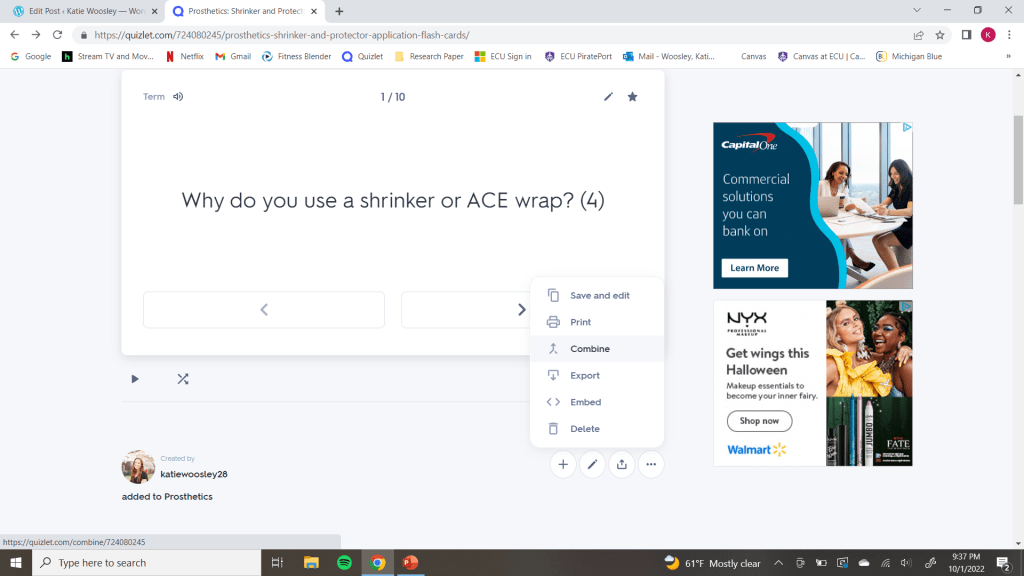
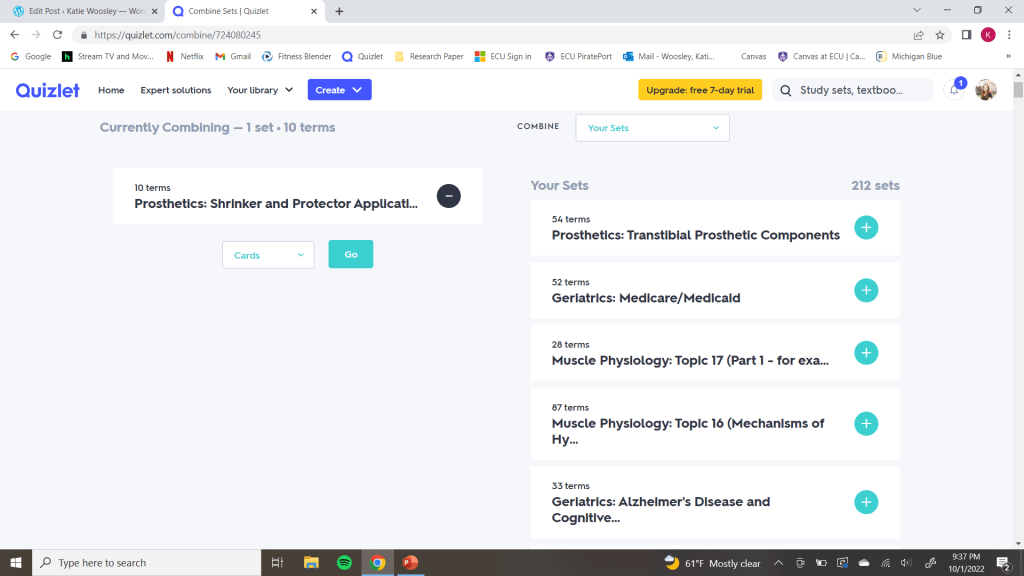
This is hands-down the #1 thing that has gotten me through PT school so far. An actual lifesaver. I made a few Quizlets throughout high school and undergrad, but now, I make them for almost every lecture in every class. I try to make the Quizlet the day after the lecture because it is a good way for me to review the material while also creating a study tool. It requires me not only to retype the material, but it also makes me think about it a little more in depth as I try to think of ways to word the flashcards. I would recommend organizing them into folders because the sets accumulate fast with the amount of material you have…I probably have close to 200 sets at this point. I try to stay on top of the information by studying them a little bit at a time, and then ,once exam time nears, I start studying them more. What’s great is you can also combine sets to study as one big set. I like to do this as a final last review right before an exam. I star any terms I don’t know, and just keep going through them until I (hopefully) know them all. I also have the Quizlet app on my phone which is great if I want to study on the treadmill or if I just want to lay in my bed and study instead of sitting at my desk. 🙂
Draw/Write Things Out
This technique depends on the class. For some classes, I never draw things out, but for others, it is a big portion of my studying. I talked about in my “All About Gross Anatomy” post how I was constantly drawing things out. I’d say gross and neuroscience are the two classes I have done this for the most. I spent so long drawing out all of the different nerve tracts over and over in neuroscience and it helped me so much! There are also a lot of different lists and scales to learn and the best way I’ve found to remember them is writing them over and over again on my whiteboard.

Talk it Out
In undergrad, I was very much a person who liked to study alone. I still like to start by studying alone, but once I have a decent grasp of the information, I find group studying so helpful! My roommate is in my program as well, and we often spend time talking through information, teaching each other, and quizzing each other. She often has ways to remember things that I hadn’t thought of and vice versa. Since we have come back from clinical, we also sometimes have patient examples to apply to concepts and help us learn. Even if everyone in your group understands the information, talking it out can help you remember it.
Re-watch Lectures
In my program, almost all of our lectures are recorded and uploaded into a system so that we can re-watch them as we need. Most of our lectures are between 2-4 hours, so I only re-watch them if I was confused on a topic and need more clarification. However, some of my classmates re-watch most lectures as a way to study. It all depends on the person!
Make Outlines
I don’t personally make outlines, but I know my roommate and several other classmates do. While I make Quizlets after lecture, my roommate goes through the PowerPoints and makes an outline of the information, adding in any notes she took with it. She even puts some pictures on them. Then, once she finishes, she prints them out because she likes having a physical copy she can write on.
Make a To-Do List/Schedule
If you don’t have somewhat of a study plan, you can easily become overwhelmed. Now that I have been in PT school a while, my study plan has become more of a mental list instead of a physical one, but in the beginning, I would recommend writing it out. By making some goals for the day or week (I personally like taking it day by day), it sets your focus so you don’t look at everything wondering where to start.
Use a Pomodoro Timer
We all know we should take breaks while studying, but I often find myself getting distracted, taking breaks too soon, or not taking them enough. On days where I can’t seem to stay focused, I love using this online Pomodoro timer to keep me on track. It has 25 minutes of work time with 5 minute breaks. Then, after several rounds you have a longer 15 minute break.
Do Not Wait Until the Last Minute!
Once again, we all know that we should not cram before an exam, but I’m sure most of us have. However, in my experience, it is nearly impossible to cram in PT school! In addition, the information you are learning builds on one another and is so important for your future career, so you no longer want to be learning concepts at the last minute and forgetting them a week later. If you study little by little not only will you be less stressed, but it will help you remember the information long-term.
My General Process of Studying
I thought I’d wrap up with a quick run-down of the study process I go through for the majority of my classes. Once again, every class is different, especially the ones that are more lab than lecture-based, but this is what I do in an ideal situation.
- During lecture – Be as focused as possible and take good notes.
- Day after lecture – Review PowerPoint slides and make Quizlet as I go.
- Several weeks before exam – Review Quizlets little by little (I try to do one a day for each class, but it depends what else I have that week). Start to draw out things as needed.
- Week of exam – Go through PowerPoints again and study corresponding Quizlet after each one. Talk through concepts with classmates.
- 1 – 2 days before exam – Review all Quizlet cards. Review other peoples’ Quizlet cards.
- Day of Exam – Depends on time, amount of information, and how good I feel, but I usually review any topics/Quizlet cards I am unsure of and go through all the cards once more if time allows. I also draw/write out stuff one last time.
 Katie Woosley
Leave a comment