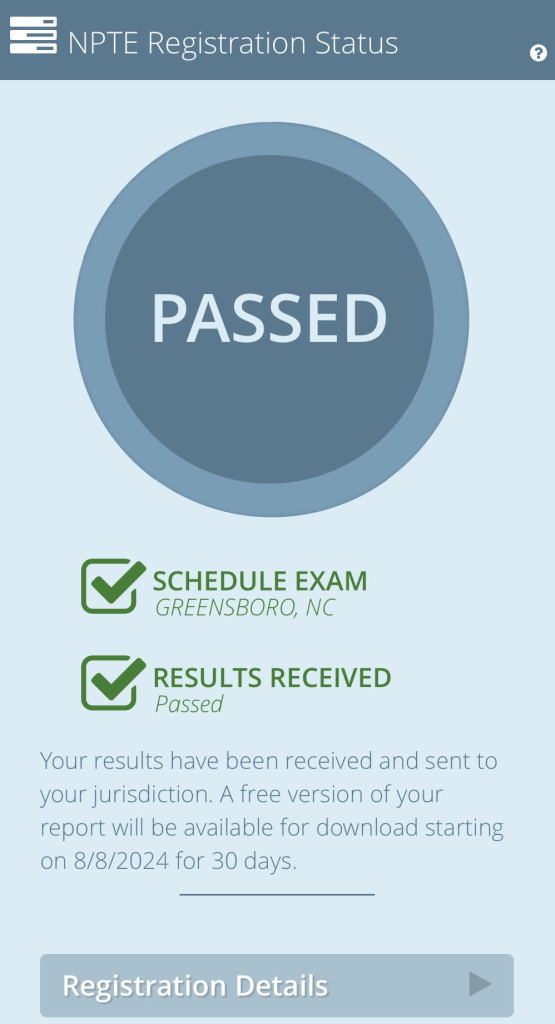
It was such a relief to walk across that stage in May and officially become a Doctor of Physical Therapy. However, I knew there would be one final step before it was fully official, and I could began my career. I had to take and pass the National Physical Therapy Exam (NPTE). The NPTE is a 5 hour, 225 question licensing exam which tests our knowledge on everything we learn in school (and more). The week between taking the exam and getting the results was one of the longest weeks of my life. I tried to keep my mind off of it by going out of town, hanging out with friends, working, and lots and lots of baking. Finally seeing that big green check signifying that I passed was a huge weight lifted off my shoulders!
As I sat down to begin my first day of studying for the NPTE, I honestly had no clue where to start. I found myself googling all about study materials, study plans, and other peoples’ experiences. This was helpful to read about but also caused me to be somewhat more overwhelmed than before because there are SO many options, and I was worried I wasn’t doing enough. I had to take a step back and remind myself that everyone is different, and there is no perfect plan or study tool. So, I’m going to share what I did and what worked for me, but I encourage you to take time to find what works best for you.
My Study Timeline
My school has us take a comprehensive (comp) exam, which was a practice NPTE exam from Scorebuilders, before graduation, so there were two “phases” to my studying. I studied for the comp exam for about 3 weeks. After the exam in April, I took a break before starting my studying back up the third week of May for the July NPTE. I studied for 2-4 hours a day, took a practice exam most Saturdays, and made sure to take one rest day at some point during the week. I worked about 25 hours/week during the summer, so I wanted to give myself plenty of time to prepare.
Preparing for the Comprehensive Exam
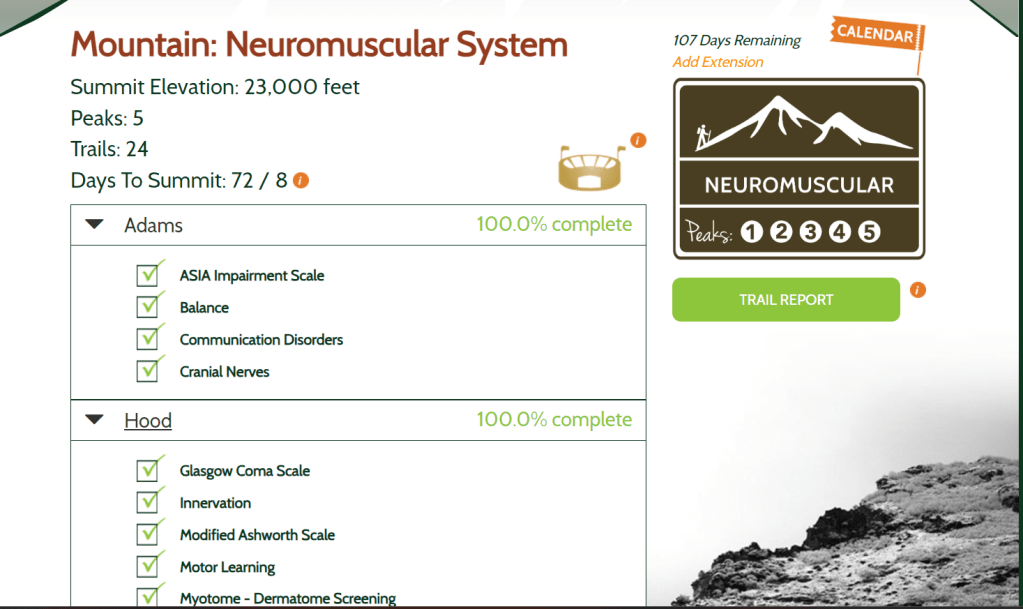
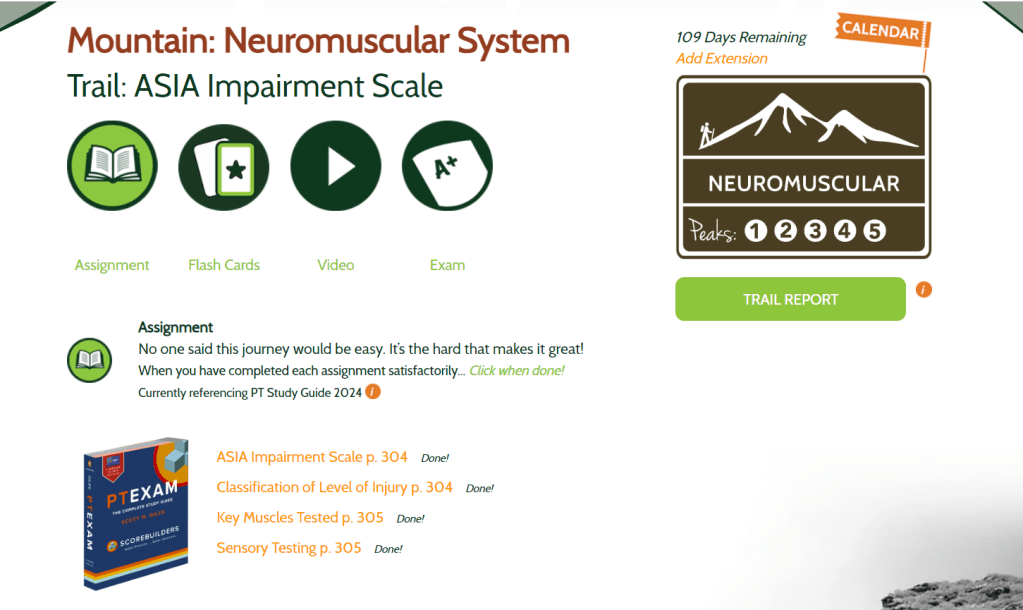
I used the Scorebuilder’s book in combination with their basecamp program to prepare for comps. The Scorebuilders book is huge, but I thought it broke down topics well, and I loved how it had a lot of tables and pictures. Basecamp takes you through the entire Scorebuilders book with various length plans to break up your studying. There was not much time between the end of my final clinical and the exam, so I used their shortest plan (30 days) and completed a little extra work each day to finish in time. In addition to a list of readings for each topic, basecamp has flashcards, videos, and quizzes. All of this was great for foundational knowledge, but the quiz and video questions do not involve clinical reasoning which is important for the actual NPTE. Overall, I’m thankful I purchased basecamp, because it gave me a plan, and I knew what I needed to do each day, which was crucial when I only had a a few weeks to study. I purchased the 1 year access because I thought I would use it as I prepared for the NPTE, however, I only used it for comps, so one of the shorter access passes would have been sufficient for me personally.

Phase 2: Preparing for the NPTE
Normally, I’m a write out the plan with all the checkboxes kind of girl. I had this for comps, and this is what I was looking for when I began my studying. for the NPTE. My initial thought was to follow a study plan from Scorebuilders which took you straight through the book from cover to cover. The issue was I had already read and highlighted the entire book preparing for my comp exam and I could not bear the thought of doing it all again. I quickly found myself doing more staring into space than reading, and I knew this method of studying was not going to work for me.
I ended up not using a specific plan to study, which worried me at first, but looking back, I think it actually helped me. It allowed me to be more flexible and change my strategies based on what I was learning and how focused I was that day. I also happened to rupture my eardrum in June, which greatly impacted my studying for a while. A great example of why it’s a good idea to start studying early because life happens and there will be days that don’t go as planned. 10/10 do not recommend rupturing your eardrum a month before the biggest exam of your life, but I’m thankful I had some buffer time which allowed me to take some extra rest days.
With that being said, instead of a set study plan, here are the resources I found helpful to prepare for the NPTE. I’ll add a list at the end for easy access.
Scorebuilders Content Prompts + Quizlet
Instead of reading the Scorebuilders book again, I decided to go back to my tried and true way of studying—Quizlet. Anyone in my class knows that Quizlet is what got me through PT school, so why change it up now? The workbook we received from our Scorebuilders class hosted by my school had content prompts, which are list of topics broken down into sections. The content prompts take you through the majority of the book, with the exception of pathologies. Fortunately, I had made a study guide for pathologies as I was reading through them preparing for the comp exam, so I used that to review those periodically. I would go through 1-2 pages of content prompts each day making Quizlet cards as I went. If I didn’t understand a topic I would take time to go back to class notes, watch videos, or talk to my classmates to learn more. This active way of studying worked so much better for me than simply reading the book, and it gave me a study tool to review the topics later. I aimed to review at least one Quizlet each day.


Practice Exams
I took A LOT of practice exams leading up to the NPTE. I found that this was how I learned best and was able to retain more information. Practice exams are expensive, but I definitely think they were worth it. We received 2 from our school and our Scorebuilders book came with 3, so this helped a little with the cost. I took 10 practice exams in total — 2 of them being before comps, 1 being the comp exam itself, and the rest being in preparation for the actual NPTE. Taking practice exams not only allowed me to practice taking questions, but it also let me see what sections I needed to improve on and where to focus my studying. The day after taking practice exams, I would review each question (even if I got them correct), taking notes on anything I didn’t know or remember and making a list of topics I needed to review more in depth. I tried to make the exam experience as similar to the NPTE as possible, taking them in the mornings in a quiet space and only taking breaks after each section. This helped me increase my test-taking endurance. I used 3 different types of practice exams: Scorebuilders, Therapy Ed, and the PEAT.
- Scorebuilders: I liked the Scorebuilders’ exams to prepare for comps and to use at the beginning of my prep for the actual NPTE, however, I found their questions to be more information recall than clinical reasoning. The Scorebuilders’ exams are also only 4 sections long rather than 5. It doesn’t seem like one more section would make that much of a difference as far as fatigue, but it definitely does! I would recommend utilizing these at the beginning of your study plan when you are still reviewing all of the foundational knowledge.
- TherapyEd: I actually found these exams to be slightly harder than the NPTE and scored lower on them, but I feel like I gained more from them than Scorebuilders, as they involved a lot more clinical reasoning. They are also 5 sections long like the NPTE rather than 4. The score reports and question explanations are very thorough. One downside to TherapyEd is they lack break screens after each section, so you have to pause the exam and add your own. The practice exams came with the TherapyEd textbook (I got the online version) but I preferred the Scorebuilders book. I found TherapyEd much more difficult to read.
- PEAT: If you are only going to buy 1 set of practice exams it should be this one because they are from the FSBPT. It comes with 2 exams — a practice exam they create and a retired NPTE exam. I took these 2 exams towards the end of my studying, and I am so glad I did. The FSBPT states that 99.3% of those who pass the PEAT exam go on to pass the NPTE, so passing these exams helped give me more confidence as I headed into the NPTE.
TrueLearn Question Bank
I was introduced to TrueLearn when a classmate shared about a free practice exam they were offering. I liked the way they worded their questions and explanations, so I decided to purchase a 30 day access to their question bank, which has about 1800 questions. This became my primary way of studying the final few weeks before the exam. They have a wide variety of questions, and I found the way they were worded comparable to the NPTE. They give very thorough explanations for all answer choices which I really liked. Each time I took them, I would read through the explanations and spend time reviewing any topics I didn’t understand or was consistently missing. They also have an app which made it easy to study when I didn’t have my computer.
PT365 Question of the Day App
The PT365 app is created by Scorebuilders and provides a free practice NPTE question each day. I started using this app my second year of PT school. I actually became so used to doing a question each day that I opened the app the first day after the NPTE before realizing I didn’t have to study anymore. The app gives good explanations and allows you to see your performance in each category. Just like basecamp, the questions are more information recall than clinical reasoning, but I still found it useful. The only downside is it repeats questions sometimes.
Kyle Rice Podcasts
This was my favorite study tool for on the go! I started listening to it consistently during my commute to my final clinical. As the NPTE approached, anytime I was in the car I always tried to listen to at least one episode. During each podcast, he goes through a practice question and takes time to talk through each answer choice. He gives great explanations as well as test-taking strategies. There is one podcast posted a week, but they go all the way back to 2018, so there are plenty of episodes available.
One Final Tip—Do Not Study All Day!
My last and most important tip is do not study all day! During comps, I studied 7-8 hours a day which was sustainable (barely) for 3 weeks but definitely not for 9 weeks! Having a job during NPTE prep is not for everyone, but I am so thankful I did because it forced me to focus on something other than the exam. Take time to do things you enjoy! Go to the gym, hang out with friends, or watch a movie. I promise your studying will be much more productive when you take time to fill your cup!
Study Resource Summary
- Completed PT365 question each day
- Listened to at least 1 (often more) Kyle Rice podcast each day during commutes
- Used Scorebuilders book and basecamp to prepare for comprehensive exam so I had already went through book once before studying for the NPTE
- Used content prompts and making Quizlets as a way to go through the Scorebuilders book again
- Studied Quizlets I made throughout, aiming for at least 1 each day
- Once getting through the first 2 big topics (musculoskeletal and neuromuscular) started taking practice exams and continued taking about 1 each week. Reviewed each practice exam in depth and took time to review topics I missed
- Scorebuilders (5 exams), TherapyEd (3 exams), PEAT (2 exams)
- Used TrueLearn practice question bank for 30 days before exam
 Katie Woosley
Leave a comment