A few weeks ago, I posted all about my first clinical experience. Then, finals for our summer semester started, and things got a little crazy! Now that finals are over, I finally have some time to sit down and write. If you haven’t read part one of my first clinical experience, I would recommend starting there. If you have read it, you know that I LOVED clinical and learned so much! Clinical was a brand new experience for me and very different from being in the classroom, so, today, I wanted to share some tips for any PT or other healthcare student going into their first clinical.
Reach out to your clinical site in advance.
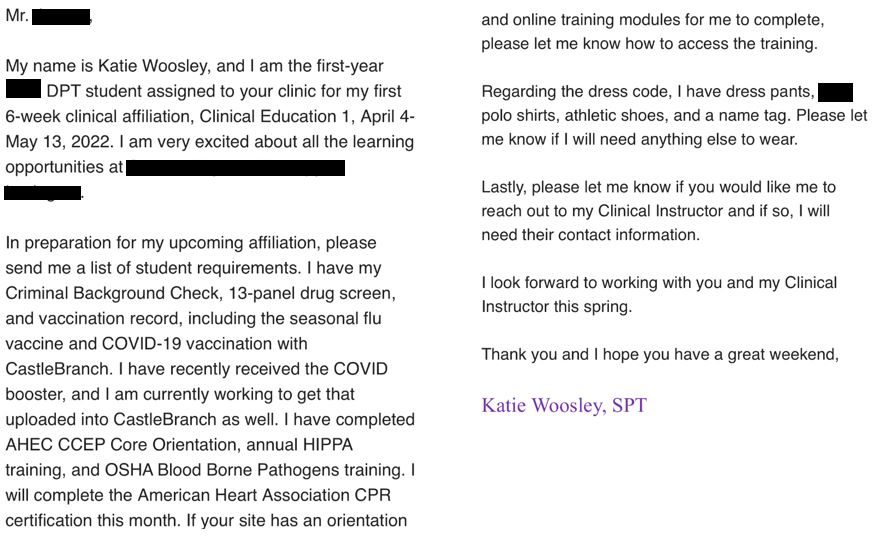
This may not be the case for all programs, but my program tells us when it is time to reach out to our site coordinator through email. I emailed my site about two months before my rotation start date. In the email, I included my name, school, year, and the dates of my clinical rotation. I listed all of the paperwork I had completed (vaccinations, background check, etc.) and asked if there were any other requirements or trainings I needed to complete. I asked about the dress code, and if they wanted me to reach out to my clinical instructor (CI). Remember to be professional and positive in the email!
Every clinical site is different, but my site coordinator attached my CI to the initial email, and she reached out to me a few days later. Once you connect with your CI, you can find out information about your schedule, parking, anything you need to bring, and an overall idea of what to expect. My CI made this process super easy by attaching an introductory letter answering all of these questions before I even asked.
Communication is key!
This is probably the number one thing to keep in mind when going into any clinical rotation. It is so important to communicate with your CI about how you are feeling, how you can improve, and goals you have. Here are some things I think are the most important when it comes to communication:
- Express when you are feeling overwhelmed – I am a fairly introverted person and am also the worst about saying “I’m good” when I’m actually not, so this is something I definitely struggled with, especially in the beginning. PTs can do a lot of things, but reading minds isn’t one of them, so in order for your CI to best help you, you need to talk to them. In my case, my CI was good at reading my facial expressions (even under the mask), so she usually knew when I needed help. If you are like me, know that this does get easier! The first week I was very quiet, but by the end of week two, I became much more comfortable talking with my CI and the other therapists in the clinic. I found it easy to say “I can do this part of the evaluation but I may need help with this part.” For example, I ankle goniometry and I are not friends. Although I did get better with it, I still asked for help to make sure it was correct every single time 🙂 .
- Ask for feedback – The purpose of clinical is to learn and you learn through feedback. My CI would give me feedback often, but if she didn’t and I was questionable about something I would simply say, “How do you think I did?” or “Would you have done anything differently in this situation?”. When I received feedback whether it be on a manual skill, documentation, or patient education, I would try to apply it as soon as possible to help me remember. Sometimes, I would ask my CI “Was ____ better this time?”.
- Know the expectations – The first day, my CI talked to me about how clinical would work and her expectations for me. She also asked me about any specific expectations my program had and what courses I had taken so far. This conversation helped give me an idea of what to expect and is an important one to have at the beginning of clinical.
- Ask questions – Once again, you are there to learn and your CI wants to help you, so ask questions! Ask how they performed a certain manual technique, how to best document something, why they chose one exercise over another, or about a certain pathology. However, make sure you are asking questions at the appropriate time. Some questions can be asked in front of a patient, while others may be best asked after the appointment is completed. You also want to avoid interrupting the flow of an evaluation or treatment. To avoid this, I would usually wait until after the appointment was finished to ask questions. I would often write them down if I thought I would forget.
Reflect on experiences and set goals.
Right after every evaluation and some treatments, my CI would always ask me two questions: “What went well?” and “What could you have done better?”. After I answered, she would give me her thoughts. I know not every CI will do this, but it is something I found helpful. I remember one evaluation in particular where everything seemed to be going wrong, and I jokingly (well, kind of jokingly) answered “nothing” to the first question, while I had multiple answers for the second. It took me a while to come up with something that went well, but I did. It is so easy to focus on the negative parts of an experience, but I like how these questions force you to find a positive as well.
At the end of the first week, my CI had me write down three specific goals I wanted to accomplish during the second week. They were simple goals, such as “complete and document the subjective portion of an evaluation” or “learn the different charge codes.” Although my CI did not ask me to do this again, each day on my way home I would reflect on the day and think of something I wanted to accomplish the next day. Sometimes my CI would tell me a goal she had for me that day. Whether you write them down or take a mental note, I think it is super important to make goals and strive to accomplish them.
When asked if you want to try something, always say YES!
I believe it was the second day of clinical when my CI asked me if wanted to go over an attendance sheet with a patient. I had heard her do so a couple times and was perfectly capable, but in my head I thought, “You want me to go talk to this patient by myself?!” I hesitated and then she finally said, “The correct answer is yes.” Looking back, the fact that I was nervous about something so simple makes me laugh, but this conversation stuck with me because of my CI’s response. The only way you are going to learn is by trying, so say yes! No one expects you to be perfect, but they do expect you to be willing to try! Going into this clinical I had not learned any treatment yet, so most of the manual techniques and exercises were new to me. I had to practice a lot to become comfortable performing them. I would always review the patient’s chart before their appointment so I could ask my CI about anything I needed help with. If I was unsure about how to perform something, I would have her show me or practice it with her before the patient arrived.
Have an open mind and positive attitude.
In order to get the most out of your clinical experiences, go in with an open mind and a positive attitude. Every clinic and physical therapist is different. They may not do things exactly as you learned in school and that’s okay. No one is expecting you to be a perfect clinician, but they do expect you to work hard and be willing to learn! Try to relax, enjoy the experience, and soak up all the knowledge you can!


Leave a comment